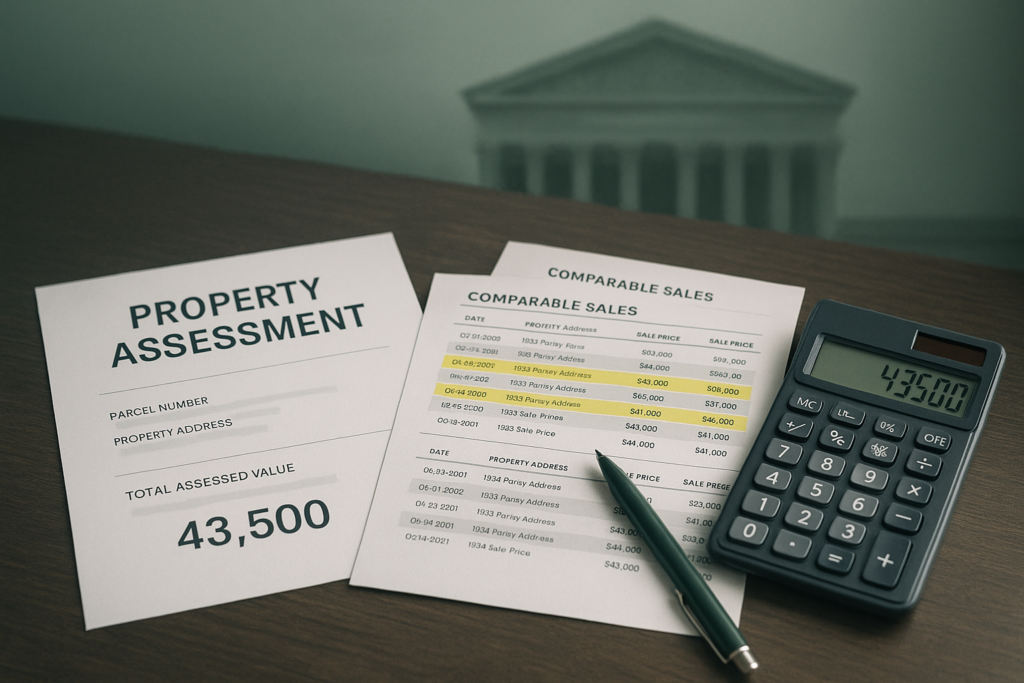

A lot of homeowners see the county assessment, compare it to a Zestimate or a sale price, and assume one of the numbers must be wrong. Usually they are just answering different questions.
Need the tax angle first? Start with the Property Tax Guide for Homeowners.
Quick answer: Assessed value is the number your taxing authority uses to help calculate property taxes. Market value is what the home would likely sell for in the open market. Market value helps with buying, selling, refinancing, and equity. Assessed value matters mainly for taxes.
| Category | Assessed value | Market value | What to use it for |
|---|---|---|---|
| Main purpose | Property tax calculation | Sale, refinance, appraisal, equity tracking | Different jobs entirely |
| Who sets it | County or local tax authority | The market, often measured through appraisals and comps | One is administrative, one is transactional |
| How often it changes | On the assessment schedule | Whenever the market moves | Market value can move faster |
| Can exemptions or caps affect it? | Yes | No | Tax value can be artificially lower |
| Should it match? | Not necessarily | Not necessarily | Mismatch alone proves nothing |
Assessed value is mostly a tax number. Market value is the real-world price number. They answer different questions on purpose.
Use assessed and taxable value when reading the tax bill or deciding whether to appeal. Use market value when selling, refinancing, removing PMI, or measuring actual equity. A mismatch alone does not prove anyone is wrong.
Homeowners waste energy arguing that one number must match the other. It does not. The smart move is using the right number for the right job and only comparing them when a tax appeal or reset issue is really on the table.
Scenario picker
Read the tax bill
Best for: you want to know why taxes rose or whether exemptions posted
Why it wins: Assessed and taxable value matter first.
Price or refinance the house
Best for: you care about real sale or lending value
Why it wins: Market evidence matters first.
Check for overassessment
Best for: the county number looks too high relative to the market
Why it wins: Now you compare both carefully and prep the appeal.
Tax number vs market number
| Decision point | Assessed value | Market value | Usually better |
|---|---|---|---|
| Main use | Property tax administration | Sale, refinance, equity | Use the one tied to the decision |
| Can exemptions/caps alter it? | Yes | No | Tax values often sit lower |
| Who sets the tone | County rules and valuation dates | Buyers, comps, appraisals, demand | Different systems |
| Best appeal use | Tax challenge support | Price and equity support | Compare both only for tax fights |
| Main mistake | Using it as a pricing shortcut | Ignoring it on a tax problem | Wrong context breaks the analysis |
Worked decision paths
Long-time Florida owner with Save Our Homes cap
Call: Expect assessed value to sit far below market
That gap can be normal and even desirable for taxes.
Recent buyer shocked by the new tax bill
Call: Check reassessment and exemptions
The seller’s old protected number was never your future bill.
County value jumps beyond nearby comparable sales
Call: Prep the appeal
That is when the market comparison becomes useful for a tax dispute.
Risk and reward cards
Assessed-value upside
- Useful for tax analysis
- Can reveal exemption savings
- Supports appeals when compared properly
Assessed-value risk
- Bad pricing shortcut
- Can lag market reality
- Buyer assumptions often go wrong after closing
Market-value upside
- Better equity analysis
- Supports sale and refinance choices
- Anchored by comps and appraisals
Market-value risk
- Not the tax bill driver
- Can distract from exemption issues
- Automated estimates are imperfect
Bottom line
Use assessed value for tax questions, market value for money-and-equity questions, and compare them only when you are seriously testing an assessment.
Best next move
Read the assessment notice line by line, then pair this with how to lower property taxes and the Florida homestead guide before deciding whether the county is actually wrong.
Best choice guidance: when each number matters
- Use assessed value when checking your tax bill, exemptions, and whether an appeal makes sense.
- Use market value when you care about sale price, refinance eligibility, PMI removal, or true equity.
- Use both when deciding whether your tax assessment is inflated relative to actual market evidence.
Worked scenarios: where people misread the numbers
Scenario 1, Florida homeowner with Save Our Homes protection: market value might be $525,000 while assessed value is $365,000 because the tax cap held down annual increases. That does not mean the county forgot how much the home is worth. It means the cap is doing its job.
Scenario 2, newly purchased house: the prior owner paid taxes on a much lower assessed value, then you buy at a much higher market price. After the reset, your tax bill jumps. Buyers miss this constantly.
Scenario 3, possible overassessment: your assessed value jumps to $440,000 but recent similar sales suggest $395,000 to $405,000. That is when comparing assessed value to market evidence becomes useful.
Why assessed value can be much lower than market value
- Homestead exemptions
- Assessment caps or portability benefits
- Lag between assessment cycle and current market conditions
- Local tax methodology that does not mirror exact sale pricing
Mistakes that cost homeowners money
- Using assessed value to estimate list price. Tax numbers are not a pricing strategy.
- Assuming low assessed value means low insurance need. Wrong category entirely.
- Ignoring a high assessment because the market is rising. You still need evidence, not assumptions.
- Buying based on the seller’s old tax bill. Your bill can reset much higher after closing.
Quick comparison for common homeowner questions
| If you want to know… | Look at | Why |
|---|---|---|
| What the house might sell for | Market value | That reflects buyer behavior and comps |
| Why taxes are high | Assessed value and taxable value | That drives the bill |
| Whether to appeal taxes | Assessed value vs market evidence | You need both numbers |
| How much equity you really have | Market value | Tax value can lag far behind reality |
The bottom line
Assessed value is mostly a tax tool. Market value is mostly a real-world pricing tool. If you use assessed value for sale or refinance decisions, you will misread your position. If you ignore it entirely, you may miss a tax problem or an appeal opportunity.
Next step: Compare your latest assessment notice to recent nearby sales, then read How to Read Your Property Tax Assessment and How to Challenge Your Property Tax Assessment if the gap looks suspicious.
Sources reviewed
- Florida Department of Revenue property tax and exemption guidance
- Florida Department of Revenue Value Adjustment Board appeal guidance
- County property appraiser assessment and exemption references
- County tax collector billing and millage references
Official resources and reference points
This page is homeowner education, not a property-specific appraisal, legal opinion, tax advice, or lender/carrier instruction. Use the tax bill, trim notice, exemption status, and local filing deadline before you assume the problem is the assessed value itself.
Why this article is worth trusting
Caleb Hollis reviewed this page. He reviews homeowner education on home value logic, cost realism, Florida housing questions, and decision quality.
See the reviewer profile and editorial team profile for who does what. OwnerHacks publishes homeowner education, not property-specific appraisal work, legal advice, tax advice, lending advice, or insurance advice.
OwnerHacks updates articles when rules, costs, or homeowner decision factors materially change. If something looks outdated, use our contact page and we will review it.