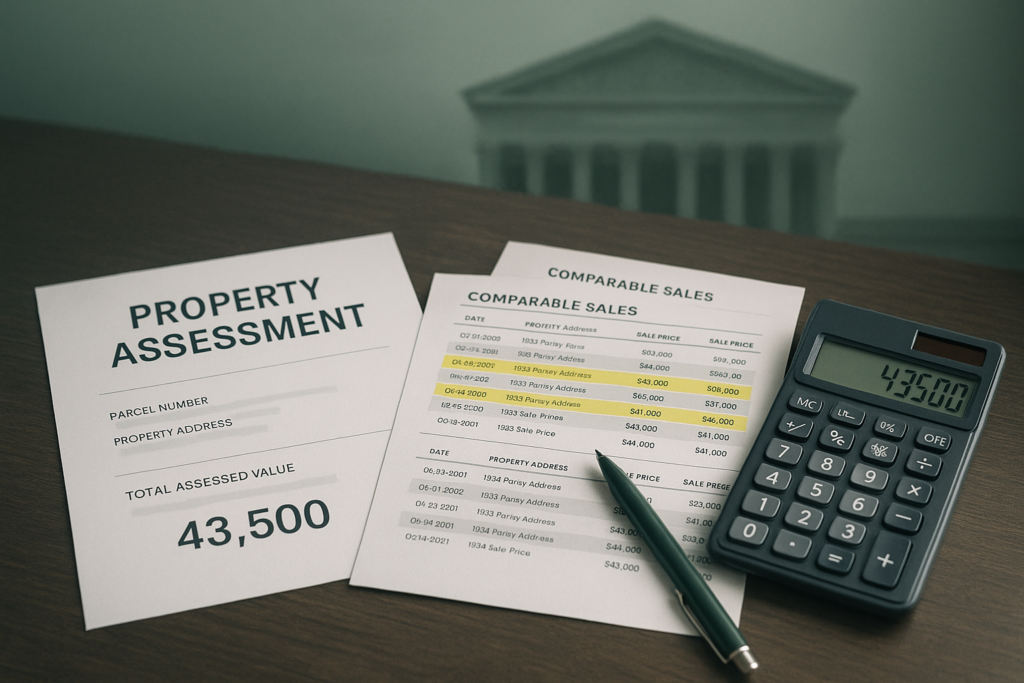

Assessment-notice page. Use this for assessed value, property record errors, comparable evidence, and whether the assessment is worth challenging.
Once a year, your county tax assessor drops a property tax assessment on you — a document that dictates exactly how much you owe. What do most homeowners do with it? Glance at the number. Maybe wince. Toss it in a drawer.
Working through a confusing assessment notice? The Property Tax Guide for Homeowners walks through the bigger system, including bills, exemptions, and appeals.
Bad move.
Assessment errors are shockingly common. The National Taxpayers Union estimates that 30–60% of U.S. properties are over-assessed. Let that number land. That’s potentially millions of homeowners quietly overpaying, and most of them have no idea.
What’s on a Property Tax Assessment?
A few key data points show up on every assessment. Here’s what to look for:
- Assessed value — The dollar amount your county slaps on your property for tax purposes. It’s often different from market value, and it’s the number that actually drives your bill.
- Property details — Square footage, bedroom and bathroom count, lot size, year built, construction type. The basics.
- Exemptions (Homestead, senior, veteran, disability) any deduction that chips away at your taxable value.
- Tax rate (millage rate) — The multiplier applied to your assessed value. Small changes here create big swings in your bill.
- Year-over-year comparison — Shows whether your assessment went up, down, or held steady from last year.
Where to Find Your Assessment
Counties typically mail assessment notices once a year — spring or summer, usually. But you don’t have to wait for the envelope. Go online, search “[your county] property appraiser,” and pull up your address. Takes two minutes.
Common Errors to Watch For
This is where things get interesting. These are the quiet mistakes that inflate your tax bill year after year, and nobody flags them unless you do.
1. Wrong Square Footage
The single most common error. Your assessor’s records might list 2,200 square feet when your home is actually 1,950. Doesn’t sound like much? Size is one of the biggest drivers of assessed value. Even 250 square feet of difference can mean hundreds of extra dollars — every single year.
Compare your assessment to your home’s actual measurements. If you still have your original appraisal report, that’s your best source for accurate numbers.
That’s not nothing.
2. Incorrect Property Details
Four bedrooms listed when you only have three? A garage that was converted to living space years ago — still showing as a garage? How about a pool that doesn’t exist?
These aren’t harmless typos. Every one of them nudges your assessed value higher than it should be.
3. Missing Exemptions
Here’s one that stings. Homestead exemptions save thousands. But they don’t always kick in automatically. In Florida, the homestead exemption can knock up to $50,000 off your taxable value. Buy a new home and forget to file? You’re just handing the county extra money.
Senior citizen exemptions, disability exemptions, veteran exemptions — all commonly missed. Check with your county office to see what applies to you.
4. Comparable Sales Don’t Match
Assessors estimate your home’s value using comparable sales. But sometimes those comps are garbage — homes in nicer neighborhoods, with more upgrades, or built decades later. If your assessed value feels high, pull up recent sales in your immediate area. Do they actually support the number on your notice? Often, they don’t.
5. Land Value Errors
Every assessment splits your property into two buckets: land and improvements (the building). Land values get inflated when the assessor uses wrong zoning classifications or incorrect lot dimensions. It’s a less obvious error. But it hits your wallet just the same.
How to Challenge Your Assessment
Found something wrong? Here’s the playbook:
- Start with a phone call. Seriously. Many errors get fixed with a simple call to the assessor’s office. Bring documentation. Your survey, appraisal report, photos, and keep it straightforward.
- File a formal appeal if that doesn’t work. Every county has a process, and every process has a deadline. Miss it? You’re locked in for another full year.
- Build your case. Comparable sales from your area. An independent appraisal if the stakes are high enough. Photos of your property’s actual condition. Anything that proves the assessment is wrong.
- Show up to the hearing. Most jurisdictions use a Value Adjustment Board or equivalent. Be organized, be factual, bring copies of everything. This isn’t the place for emotion. It’s the place for evidence.
When It’s Worth Hiring Help
Simple stuff — wrong square footage, a missing exemption. You can handle that solo. But if your assessed value is way above market value and the gap is costing you real money? That’s when a property tax consultant or a real estate appraiser specializing in tax appeals earns their fee.
Most consultants work on contingency. They only get paid if they actually save you money. Low risk for you, and strong motivation for them.
Don’t Ignore It
Your tax assessment isn’t bureaucratic noise. It’s the document that sets your bill. Spend 15 minutes reviewing it each year. If something looks wrong, push back.
Worst case? They confirm the assessment is accurate. Best case? You pocket hundreds — maybe thousands. That you’d otherwise overpay. Worth it? Absolutely.
Want more ways to cut your property tax burden? Read our guide on 7 strategies to lower your property taxes.
Sources reviewed
- Florida Department of Revenue property tax and exemption guidance
- Florida Department of Revenue Value Adjustment Board appeal guidance
- County property appraiser assessment and exemption references
- County tax collector billing and millage references
Keep Reading
- Property Tax Exemptions You Might Be Missing
- Why Your Property Taxes Went Up (And What You Can Actually Do About It)
- What Is Title Insurance and Do You Really Need It?
Official resources and reference points
This page is homeowner education, not a property-specific appraisal, legal opinion, tax advice, or lender/carrier instruction. Use the tax bill, trim notice, exemption status, and local filing deadline before you assume the problem is the assessed value itself.
Why this article is worth trusting
Caleb Hollis reviewed this page. He reviews homeowner education on home value logic, cost realism, Florida housing questions, and decision quality.
See the reviewer profile and editorial team profile for who does what. OwnerHacks publishes homeowner education, not property-specific appraisal work, legal advice, tax advice, lending advice, or insurance advice.
OwnerHacks updates articles when rules, costs, or homeowner decision factors materially change. If something looks outdated, use our contact page and we will review it.