
Florida-only pillar. This page explains Florida-specific property tax rules. For the broader topic map, use the main property tax guide.
Florida property taxes. They sound complicated, and honestly, they kind of are until somebody lays it all out. You’re thrilled about that homestead exemption one minute. The next? You’re staring at millage rates, totally lost, wondering how your neighbor’s tax bill is $3,000 cheaper on a nearly identical house.
Need the whole property-tax picture? Start with the Property Tax Guide for Homeowners, then use the deeper articles below where you need them.
But here’s the thing. Florida’s property tax system is actually built in your favor — once you know the rules. Homeowners save thousands every year just by understanding how the pieces fit together. That’s not nothing.
By the end of this guide, you’ll know exactly how your taxes get calculated, which exemptions apply to you, and (the part that matters most) how to legally shrink what you owe. No filler. Just practical knowledge that puts real dollars back in your pocket.
Quick answer: how Florida property taxes really work
Florida property taxes come down to taxable value multiplied by local millage, but the real homeowner strategy is understanding the moving parts that change that taxable value over time. Market value is not the same as assessed value. Assessed value is not the same as taxable value. Once homestead and Save Our Homes enter the picture, two similar houses on the same street can carry very different tax bills for perfectly legal reasons.
| Term | What it means | Why homeowners care |
|---|---|---|
| Just value | The county’s estimate of market value | Starting point for the tax calculation |
| Assessed value | Value after assessment limits like Save Our Homes | Can rise slower than market value on homesteaded homes |
| Taxable value | Assessed value minus exemptions | This is the number your taxes are actually based on |
| Millage rate | Tax rate per $1,000 of taxable value | Controls how hard each taxing authority hits the bill |
| Homestead and portability | Benefits for eligible Florida primary residences | Often the biggest legal tax saver available |
Florida tax decision filter
- New primary residence? File homestead on time and learn portability before assuming last year’s tax bill will transfer cleanly.
- Thinking your taxes look too high? Check whether the issue is market value, lost exemption, or simply a reset after purchase.
- Moving within Florida? Portability can matter more than people realize, especially if you have owned the prior home a long time.
- Own a rental or second home? Do not count on homestead-style protections that usually do not apply.
Worked examples: why neighbors pay different amounts
Example 1, longtime owner vs recent buyer: one owner has held a homesteaded home for 12 years and benefited from capped assessment growth. The next-door buyer just closed last year at a much higher market price. Even with similar homes, the new owner’s tax bill can be materially higher because the assessment resets closer to market after sale.
Example 2, exemption miss: a homeowner forgets to file homestead after moving in. The bill jumps because the property loses both the exemption benefit and the slower assessment-growth protection that would have started earlier.
Example 3, portability win: a seller with a large Save Our Homes gap moves to another Florida primary residence and transfers part of that tax benefit. Without portability, the new tax bill could be dramatically higher.
What changes your bill the fastest
- Buying a property and triggering a reassessment closer to market value.
- Losing homestead or other exemptions.
- Millage-rate increases from local taxing authorities.
- Major improvements that materially increase value.
- Failing to challenge a valuation issue when the county record is clearly wrong.
Next step: go deeper with Florida homestead exemption rules, Save Our Homes portability, and how to appeal a Florida property tax assessment.
How Florida Property Taxes Work
No state income tax in Florida. That’s the trade-off. Property taxes do more heavy lifting here than in most of the country. But don’t spiral — Florida bakes in several homeowner protections that other states simply don’t have.
The Basic Formula
Your tax bill boils down to one equation:
Taxable Value ÷ 1,000 × Millage Rate = Annual Property Tax
Let’s make it concrete. Say you own a home in St. Johns County worth $350,000:
- Assessed Value: The property appraiser pegs your home at $350,000
- Exemptions: You’ve got the $50,000 homestead exemption locked in
- Taxable Value: $350,000 – $50,000 = $300,000
- Millage Rate: Total millage comes to 18.5 mills (pretty standard for St. Johns County)
- Annual Tax: $300,000 ÷ 1,000 × 18.5 = $5,550
Where Your Money Goes
That single bill on your counter? It’s actually several taxes bundled together:
- County Government: Think roads, parks, libraries, and emergency services — usually 4–6 mills
- School District: Public education gets the biggest slice, typically 6–8 mills
- Municipality: City services, but only if you’re inside city limits (3–7 mills)
- Water Management District: Environmental protection at a modest 0.1–0.3 mills
- Special Districts: Fire protection, hospital districts, and other local needs — varies wildly
Location is everything. A homeowner in Miami-Dade might face 20–25 mills total. Someone in a rural county like Pasco? Maybe 12–15 mills. Two identical $300,000 homes, $3,000 apart on the tax bill. Geography alone explains it.
Assessment vs. Market Value
This is where it gets interesting. Your assessed value (what the property appraiser assigns for tax purposes) doesn’t have to match what a buyer would pay tomorrow.
Property appraisers must assess at “just value,” which is essentially market value. But Florida’s Save Our Homes amendment changes the math. Once you have homestead exemption, your assessed value can only rise by 3% per year or the Consumer Price Index — whichever is lower.
The result? Some dramatic gaps. A home that sold for $500,000 in 2023 might carry an assessed value of just $320,000 if the owner’s been there since 2010. Taxes get calculated on that lower number. Not the current market price.
Understanding Your Tax Bill
Tax bills land around November 1st. They’re due by March 31st of the following year. And there’s a carrot for paying early: November gets you a 4% discount, December 3%, January 2%, February 1%.
For a deep dive into every line on your statement, check out How to Read Your Property Tax Bill: A Line-by-Line Breakdown. Here are the sections that matter most:
Market Value Section: What the property appraiser believes your property is worth. Some counties call it “just value,” others say “assessed value.”
Exemptions Section: Every exemption applied to your property shows up here. The $50,000 homestead is most common, but look for senior, veteran, or disability exemptions too.
Taxable Value Section: Assessed value minus all exemptions. This is the number that actually drives your tax calculation.
Millage Breakdown: Each taxing authority listed individually with its own rate. Expect 4–8 separate line items.
Payment Options: Quarterly installments are available in most counties — no need to drop it all at once. Some even offer small autopay discounts of $5–15.
Homestead Exemption: Your Biggest Tax Break
This one exemption can save you $500–2,000 every single year. But, and this trips people up constantly. It’s not automatic. You have to apply.
The Two-Part Exemption
Florida splits the homestead exemption into two pieces:
- First $25,000: Hits all taxing authorities — county, school district, city, everything
- Second $25,000: Only reduces non-school taxes, and only kicks in when your home’s assessed value tops $75,000
Most homes clear both thresholds easily. Back to our St. Johns County example:
- Without homestead: $350,000 taxable value × 18.5 mills = $6,475 per year
- With homestead: $300,000 taxable value × 18.5 mills = $5,550 per year
- Annual savings: $925
Save Our Homes Cap
Here’s the hidden gem. Once homestead is in place, the Save Our Homes amendment caps your assessment increases at 3% per year, or the inflation rate, whichever is lower.
In a hot market, this protection is massive. Say you bought in Orlando in 2020 for $250,000. Comparable homes now sell for $400,000.
Without the cap? Your assessed value rockets to $400,000, and your annual taxes spike by roughly $2,250. With Save Our Homes? Your assessment nudges up about 3% each year. Manageable. Predictable. Even as your home’s market value takes off.
Portability
Moving within Florida? You can take up to $500,000 of your Save Our Homes benefit with you — whether you’re staying in the same county or crossing the state. That’s portability, and it’s a game-changer for retirees or anyone upgrading homes.
For the full walkthrough on applying and qualifying, see Florida Homestead Exemption: How to Save Thousands on Property Taxes.
Other Exemptions You Might Qualify For
Homestead is the big one. But Florida stacks additional exemptions on top, and many homeowners never even check.
Senior Exemption
Age 65 or older with household income under $30,000? You might qualify for an extra $50,000 exemption. It’s means-tested and requires reapplication every year. But for those who qualify, it can nearly wipe out the property tax bill entirely.
Veteran Exemptions
10% Disability or Higher: An additional $5,000 exemption
Combat-Related Disability: Exemption matches your disability percentage
100% Permanent Disability: Full exemption — zero property taxes
Surviving Spouse: May continue the veteran’s exemption under certain conditions
Disability and Widow/Widower Exemptions
Legally blind or totally and permanently disabled? Additional exemptions may apply. Surviving spouses with household income below $20,000 can qualify for an extra $500 exemption as well.
How to Lower Your Property Taxes
Exemptions aren’t your only lever. Several other strategies can trim your bill. We break them all down in How to Lower Your Property Taxes: 7 Strategies That Actually Work, but here’s the quick version:
- Claim Every Exemption You Qualify For — Sounds obvious. Yet thousands of homeowners leave money sitting on the table every year by simply not applying.
- Audit Your Property Records — Wrong square footage, an extra bathroom that doesn’t exist, a “pool” you’ve never had. Errors like these quietly inflate your assessment.
- Document Property Problems — Foundation cracks, aging HVAC systems, a roof that needs replacing. Get it on paper. It strengthens an appeal.
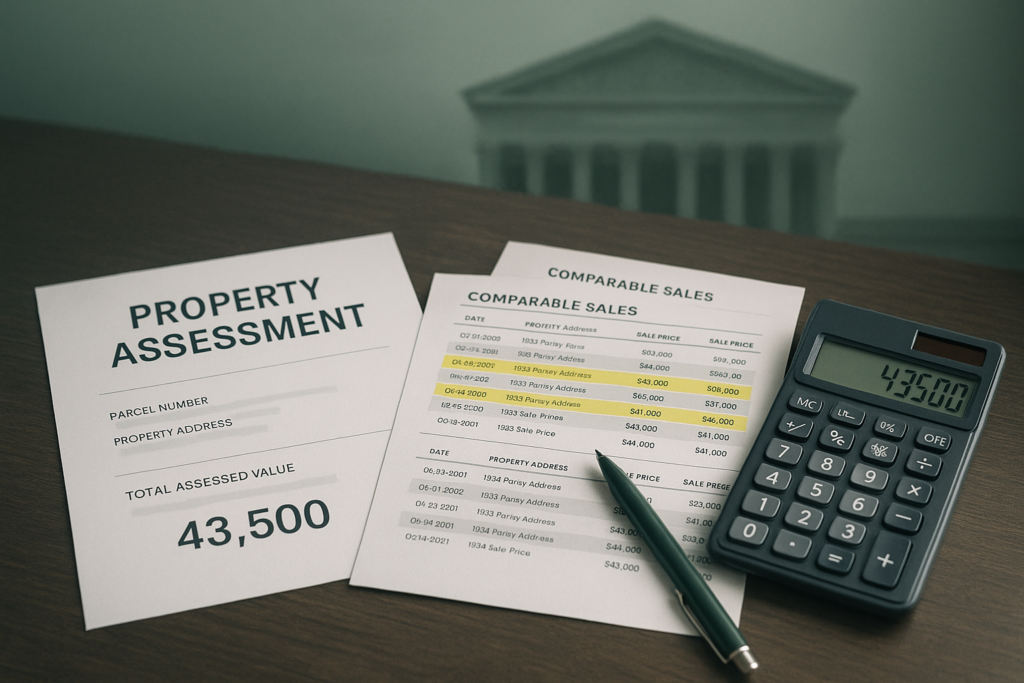
- Track Comparable Sales — If similar homes nearby sell for less than your assessed value, that’s evidence. Use it.
- Watch the Market — Declining values often take a cycle to show up in assessments. That lag creates appeal windows.
How to Appeal Your Assessment
Think your property is over-assessed? You can challenge it. Florida’s appeal process was designed to be accessible — no attorney required.
One critical deadline: appeals must be filed by the 25th day after the property appraiser mails the Notice of Proposed Property Taxes. That’s usually around August 25th. Miss it and you’re waiting a full year.
- Petition Filing: Submit to your county’s Value Adjustment Board (VAB)
- Evidence Gathering: Pull together comparable sales, photos, and supporting documentation
- Hearing: Present your case before a three-person panel — typically September through November
- Decision: The board can lower your assessment, keep it the same, or (very rarely) raise it
What wins hearings? Recent comparable sales, photos of property issues, professional assessments, and proof of record errors. Homeowners who show up prepared regularly see reductions of 5–20%. For a complete step-by-step, see How to Appeal Your Property Tax Assessment (And Actually Win).
CDD Fees: The Hidden Property Cost
Community Development Districts (CDDs) are a Florida specialty. And they catch new homeowners off guard constantly.
CDDs fund infrastructure in newer developments. Roads, water systems, parks, pools, clubhouses. Those costs land on homeowners as annual assessments. They show up on your tax bill, sure. But they’re technically not property taxes. They’re special assessments. Which means? No early payment discounts apply.
The range is enormous. Heritage Harbour South charges around $500 a year. The Villages runs $1,200–2,000. Some phases of Lakewood Ranch hit $3,000–6,300 annually. That’s a second tax bill in disguise.
And don’t confuse CDD fees with HOA dues. Plenty of communities charge both. CDDs appear on your tax statement; HOA is a separate monthly payment. For the full breakdown, see CDD Fees in Florida: The Hidden Cost New Homeowners Don’t See Coming.
What Happens If You Don’t Pay
Florida doesn’t mess around here. Taxes go delinquent on April 1st with an immediate 3% penalty. By June 1st, interest starts accruing at 18% per year, and the tax certificate sale process kicks off.
Instead of foreclosing right away, counties sell “tax certificates” to investors. Those investors pay your overdue taxes and earn 18% annual interest for doing it. You can still catch up by paying the back taxes plus interest. But if two years pass without payment? The certificate holder can petition for a tax deed sale — a court-supervised auction. And yes, you can lose your home.
For everything you need to know about the collection timeline and your legal rights, see What Happens If You Don’t Pay Your Property Taxes?.
Property Taxes When Buying or Selling Mid-Year
Ownership is assessed on January 1st, but the annual bill gets split between buyer and seller at closing — proportional to who owned the property when. Close on June 15th with a $3,650 annual bill (roughly $10 a day), and you’d owe about $2,000 for the rest of the year.
Most lenders bundle taxes into your escrow account. Your monthly mortgage payment includes 1/12th of estimated annual taxes. But those are estimates — when the actual bills arrive, any shortfall or overage triggers an adjustment. Your monthly payment can change.
First-time buyers get surprised often. Why? The previous owner’s exemptions don’t transfer. New construction assessments might not reflect the finished value. And escrow estimates were based on incomplete data. Budget for a first-year tax increase. It’s almost always higher than expected.
The Bottom Line
Florida’s system rewards homeowners who pay attention. Homestead exemption, Save Our Homes protection, a straightforward appeal process — the tools for significant savings are right there. You just have to use them.
What to remember:
- File for homestead exemption the moment you establish Florida residency — don’t wait
- Check your assessment every year for errors or inflated values
- Know your CDD fees if you bought in a newer development
- Keep records of anything that might affect your property’s value — repairs needed, structural issues, system age
- Never ignore a tax bill — the penalties stack up fast and the consequences are severe
Property taxes rank among the biggest recurring costs of homeownership. But they don’t have to be a black box. With the right knowledge, you pay exactly what you owe, and nothing more.
Sources reviewed
- Florida Department of Revenue property tax and exemption guidance
- Florida Department of Revenue Value Adjustment Board appeal guidance
- County property appraiser assessment and exemption references
- County tax collector billing and millage references
Keep Reading
- How to Read Your Property Tax Assessment (And Spot Errors)
- CDD Fees Explained: The Hidden Cost of Buying in a New Community
- Florida Homestead Exemption: How to Save Thousands on Property Taxes
This guide covers general information and isn’t a substitute for professional tax advice. Property tax laws and exemptions are subject to change. For guidance specific to your situation, contact your county property appraiser’s office directly.
Florida tax deep dives:
Official resources and reference points
This page is homeowner education, not a property-specific appraisal, legal opinion, tax advice, or lender/carrier instruction. Use the tax bill, trim notice, exemption status, and local filing deadline before you assume the problem is the assessed value itself.
Why this article is worth trusting
Caleb Hollis reviewed this page. He reviews homeowner education on home value logic, cost realism, Florida housing questions, and decision quality.
See the reviewer profile and editorial team profile for who does what. OwnerHacks publishes homeowner education, not property-specific appraisal work, legal advice, tax advice, lending advice, or insurance advice.
OwnerHacks updates articles when rules, costs, or homeowner decision factors materially change. If something looks outdated, use our contact page and we will review it.