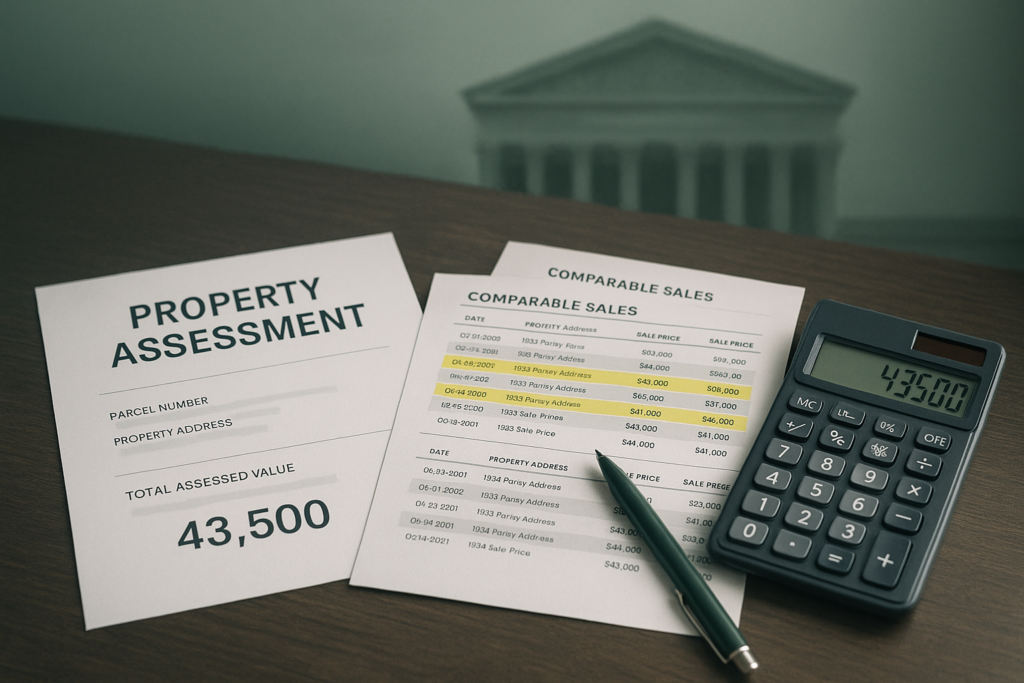

Bill-reading page. Use this for millage, non-ad valorem fees, escrow-relevant line items, and why the amount due changed. Assessment-notice errors belong on the assessment page.
Read the property-tax bill in sequence so you can tell whether the problem is value, exemptions, or a line item you should not be paying blindly.
Most owners jump straight to the total. Wrong move. The smarter order is assessed value, exemptions, taxable value, millage, then non-ad valorem charges. That tells you what actually changed and where to push back.
Check value lines first
Compare market, assessed, and taxable value so you know whether the bill jumped because of valuation or because taxable protections changed.
Audit exemptions
Confirm homestead and any other exemption actually appear. Missing exemptions are often the easiest savings win.
Read the tax-rate math
Millage rates tell you what each taxing authority is charging. This is where county, city, school, and special district pieces show up.
Separate fees from taxes
Non-ad valorem charges are often not value-based at all, so appealing value will not change them.
Use this bill-reading shortcut
- Value problem, compare with nearby sales.
- Exemption problem, fix the filing or eligibility record.
- Fee problem, identify the district or service charging it.
After you isolate the line-item problem, jump to how to lower property taxes or the Florida homestead guide instead of guessing.
Assessed Value vs. Market Value
Two key numbers on your bill: market value (what the assessor thinks your property is worth) and assessed value (the number your taxes are actually calculated on). In many states they’re the same. In others, assessed value is a percentage of market value.
In Florida, if you’ve got a homestead exemption, assessed value is capped — increases max out at 3% per year regardless of what the market does. This creates a growing gap over time, which is why long-time Florida homeowners often pay dramatically less than what their home’s market value would suggest. In St. Johns County, where values have surged over the past decade, that gap can be enormous.
First thing to check: does the market value look right? If your home is worth $350,000 and the assessor says $420,000. That’s a red flag worth appealing.
Exemptions
Your bill should list all exemptions on the property. Homestead, senior, veteran, disability — each one reduces your taxable value by a specific amount.
Here’s the thing: if you qualify for an exemption that isn’t showing, you’re overpaying. Contact your county property appraiser immediately. Some exemptions can even be applied retroactively for the current year if you missed the deadline, depending on the state. Don’t just assume it was filed correctly — check.
Taxable Value
Taxable value = assessed value minus exemptions. This single number determines your actual tax bill. Everything above (market value, assessed value, exemptions) feeds into this figure.
If it looks too high, trace it backward. Market value accurate? All exemptions applied? Is the assessed value correctly capped? It’s a chain — find where the error starts.
Millage Rates (Tax Rates)
Your bill lists multiple taxing authorities, each with its own rate. A “mill” equals $1 of tax per $1,000 of taxable value. You’ll see county government, city/municipality, school district, water management district, and special districts (fire, library, hospital, etc.).
Each sets its own rate during annual budget hearings. Your total tax rate is the sum of all of them. In most areas, combined rates fall between 10 and 25 mills. That’s $10 to $25 per $1,000 of taxable value. In Duval County, for example, total millage tends to run higher than St. Johns or Clay, partly because of the consolidated city-county government structure.
You can’t change these rates yourself. But you can show up to budget hearings and vote for the officials who set them. The school district portion is usually the biggest single chunk.
Property Details
Somewhere on the bill or the linked property record, you’ll find the physical details on file: square footage, bedrooms, bathrooms, year built, lot size, property type. Check. Every. One.
If the assessor has your 1,800 sf home listed at 2,100 sf, you’re being taxed on 300 square feet that don’t exist. They show 4 bathrooms when you have 3? A pool you don’t have? Those errors inflate your assessed value. Correcting data mistakes is the easiest way to lower your taxes — often takes a single phone call or online form.
Special Assessments and Non-Ad Valorem Charges
Below the value-based (ad valorem) taxes, you’ll often see non-ad valorem charges. These are flat fees that don’t depend on what your home is worth. Common ones: solid waste, stormwater, fire rescue assessments, and CDD charges.
CDD charges deserve special attention if you’re in a newer planned community in Florida. These can add $1,000–$4,000/year to your bill — essentially debt service for the infrastructure the developer built (roads, utilities, amenities). They eventually expire, usually after 15–30 years, but in the meantime they’re a significant line item that many buyers don’t anticipate.
Discount Periods and Due Dates
Many counties offer early payment discounts. In Florida: pay in November, get 4% off. December, 3%. January, 2%. February, 1%. Full amount due by March 31, delinquent after April 1 with penalties.
If you’re paying directly (not through escrow), always pay as early as possible. On a $5,000 bill, the November discount saves $200 — for literally just paying early. Free money sitting on the table.
The Bottom Line
Your property tax bill isn’t just an invoice. It’s a summary of how your property is valued, what exemptions you’re receiving, and how much each local government is charging you. Review it carefully every year. Check the details for errors. Make sure all exemptions are applied. And if the assessed value looks inflated, you have the right to appeal.
Five minutes of attention to your tax bill can save hundreds of dollars. Every single year.
Related: How to Lower Your Property Taxes: 7 Strategies That Actually Work
See also: Florida Homestead Exemption: How to Save Thousands on Property Taxes
Sources reviewed
- Florida Department of Revenue property tax and exemption guidance
- Florida Department of Revenue Value Adjustment Board appeal guidance
- County property appraiser assessment and exemption references
- County tax collector billing and millage references
Keep Reading
- How to Lower Your Property Taxes: 7 Strategies That Actually Work
- CDD Fees in Florida: The Hidden Cost New Homeowners Don’t See Coming
- Homeowners Insurance Claim Denied? Here’s What to Do Next
Official resources and reference points
This page is homeowner education, not a property-specific appraisal, legal opinion, tax advice, or lender/carrier instruction. Use the tax bill, trim notice, exemption status, and local filing deadline before you assume the problem is the assessed value itself.
Why this article is worth trusting
Caleb Hollis reviewed this page. He reviews homeowner education on home value logic, cost realism, Florida housing questions, and decision quality.
See the reviewer profile and editorial team profile for who does what. OwnerHacks publishes homeowner education, not property-specific appraisal work, legal advice, tax advice, lending advice, or insurance advice.
OwnerHacks updates articles when rules, costs, or homeowner decision factors materially change. If something looks outdated, use our contact page and we will review it.