- The best property tax appeals are data files, not protests.
- Scenario picker
- Decision matrix
- Worked decision paths
- Risk and reward cards
- Bottom line
Show all sections
- First, Know What You Are Actually Arguing
- The Three Questions to Ask Before You Appeal
- The Property Tax Appeal Decision Filter
- Start With the Property Record Card
- Assessed Value vs Market Value: Do Not Mix Them Up
- What Evidence Actually Wins Appeals
- How to Find Better Comparable Sales
- Example: Weak Appeal vs Strong Appeal
- Condition Matters More Than Homeowners Think
- The Neighbor Comparison Strategy
- Should You Get an Independent Appraisal?
- How to Organize Your Appeal Packet
- Hearing Day: How to Not Blow It
- Real-World Example
- The Deadline Problem
- What an Appeal Can Actually Save You
- OwnerHacks Quick Take
- Bottom Line
- Sources reviewed
Appeal process page. Use this only when you are deciding whether to file, gather evidence, meet deadlines, or challenge a specific assessment.
The best property tax appeals are data files, not protests.
Win by isolating the issue, bad facts, missed exemptions, or unsupported assessed value, then matching the evidence to that lane instead of ranting about taxes.
Scenario picker
Fix the record
Best for: square footage, bath count, or features are wrong
Why it wins: Bad county inputs can poison the assessment before value arguments even start.
Appeal the value
Best for: record is right but assessed value outruns the market
Why it wins: That is where comparable sales and condition proof matter.
Skip the fight
Best for: value is broadly supported or savings are tiny
Why it wins: Weak appeals waste time and usually change nothing.
Decision matrix
| Question | Record correction | Assessment appeal | Usually better |
|---|---|---|---|
| Best when | Facts are wrong | Facts are right but value looks high | Correct facts first |
| Main evidence | Property card and measurements | Comps, condition photos, repair estimates | Depends on the issue |
| Main failure | Ignoring factual errors | Using Zillow and emotion | Correct facts first |
| Timing risk | Can often be handled quickly | Deadline-sensitive | Move fast either way |
Worked decision paths
County counted storage as living area
Call: Lead with the property-record correction
This is cleaner and stronger than arguing abstract market value first.
Three tighter comparable sales all support a lower range
Call: Appeal with a concise comp grid
Good closed sales usually do more work than a thick packet of weak screenshots.
Taxes rose mainly because an exemption is missing
Call: Fix the exemption path, not the value
Do not force an admin problem into a value hearing.
Risk and reward cards
What helps
- Tight comp set
- Verified property facts
- Short, credible summary
What backfires
- Late filing
- Zillow-only evidence
- Turning the hearing into a general tax rant
Bottom Line
If the file is clean and the evidence is tight, appeal. If the case depends on outrage, skip it.
Best next move
Use this with how to lower property taxes, assessed vs market value, and the Florida homestead guide before filing.
A property tax appeal is not about whether your tax bill feels unfair.
It is about whether your property was assessed too high based on the rules in your area.
That distinction matters. A lot of homeowners show up angry, tell the board their taxes are too expensive, and lose. The owners who win usually do something different. They show up with clean evidence, a tight argument, and numbers that make sense.
This guide walks through how to decide whether an appeal is worth it, what proof actually matters, and how to build a case that sounds credible instead of emotional.
First, Know What You Are Actually Arguing
When homeowners say, "My taxes are too high," that can mean three different things:
- Your assessed value is too high
- You missed an exemption
- Your local tax rates are high even if the value is right
An appeal is usually strongest when the problem is the first one.
If your issue is really a missed homestead exemption or an admin mistake, fix that directly. Do not force everything into a value fight.
The Three Questions to Ask Before You Appeal
1. Is the assessor’s value above realistic market value?
If similar homes are selling for less, that is your lane.
2. Is there a factual error in the property record?
Wrong square footage, extra bath, incorrect lot data, or a finished area that is not actually finished can all matter.
3. Are you within the filing deadline?
A brilliant case filed late is still a dead case.
The Property Tax Appeal Decision Filter
Use this quick screen before spending hours on an appeal.
Probably worth appealing if:
- Your assessed value is clearly above recent comparable sales
- Your property record has meaningful errors
- Your home has condition issues not reflected in the assessment
- Similar nearby homes are assessed lower
- The tax savings could be meaningful for more than one year
Probably not worth appealing if:
- Your value is roughly in line with market sales
- You are arguing from Zillow screenshots alone
- The potential annual savings are tiny
- You missed the deadline
- You just dislike rising taxes generally
Not every high tax bill is a good appeal case.
Start With the Property Record Card
This is the most overlooked document in the whole process.
Your local assessor or property appraiser usually has a public record showing things like:
- Living area square footage
- Year built
- Bedroom and bath count
- Lot size
- Construction quality or condition rating
- Garage, porch, pool, and accessory features
Why this matters
If the county thinks your house has:
- 2,450 square feet when it really has 2,180,
- 4 bathrooms instead of 3,
- a finished room that is actually enclosed storage,
then you may be over-assessed before anyone even gets to market comps.
This is the cleanest type of appeal evidence because it attacks bad inputs directly.
Assessed Value vs Market Value: Do Not Mix Them Up
Homeowners lose credibility fast when they mix up these terms.
Market value
What a typical buyer would likely pay in the open market.
Assessed value
The value your taxing authority uses for tax purposes, sometimes adjusted by caps, exemptions, or assessment ratios.
In some areas, these numbers can differ a lot. In others, they track more closely.
Your job is to understand how your county gets from market evidence to taxable value. You do not need to become a tax attorney. You do need to stop assuming every number on the notice means the same thing.
What Evidence Actually Wins Appeals
Not all evidence is equal.
Strong evidence
- Recent closed sales of similar nearby homes
- Errors in the official property record
- Photos showing deferred maintenance or physical issues
- Repair estimates when condition is materially below typical competing homes
- Independent appraisal, when economically justified
- Evidence of inconsistent assessment compared to highly similar neighboring properties
Weak evidence
- Zillow or Redfin estimates by themselves
- Current listings without closed sales support
- What you "need" the value to be
- What you spent on improvements
- What your neighbor says their house is worth
Very weak evidence
- "My taxes went up too much"
- "I have lived here forever"
- "I cannot afford this"
Those may all be true. They are just not strong value evidence.
How to Find Better Comparable Sales
This is where most homeowners get sloppy.
A good comparable sale is not just nearby. It should also be similar in the ways buyers care about.
Prioritize these factors
- Same neighborhood or competing area
- Similar gross living area
- Similar age and design
- Similar lot utility
- Similar overall condition
- Similar quality and update level
- Recent closed sale date
Watch for common mistakes
- Using a fully renovated comp against an outdated house
- Using a water-view home against an interior lot
- Using a sale from a peak market month against a softer current market without context
- Using one cherry-picked low sale when the broader market says otherwise
OwnerHacks rule
Three solid comps beat ten random ones.
Example: Weak Appeal vs Strong Appeal
Weak appeal
"My house should be worth $375,000 because Zillow says so and my taxes keep rising."
Strong appeal
"The county record shows 2,340 square feet, but enclosed rear storage was counted as finished area. Measured living area is 2,110 square feet. In addition, three recent neighborhood sales of similar size and similar condition closed between $352,000 and $364,000. The assessment at $395,000 appears above supported market range."
The second one sounds like someone the board has to take seriously.
Condition Matters More Than Homeowners Think
Many assessments rely on mass appraisal models. Those models can miss property-specific problems.
Examples that can justify a lower value argument:
- Original kitchen and baths in a market full of updated competitors
- Older roof near end of economic life
- Significant flooring or interior finish wear
- Needed exterior repairs
- Functional problems like awkward additions or poor layout flow
- Backing to a busy road or commercial influence not reflected well in mass modeling
What to bring
- Clear date-stamped photos
- Short captions explaining why the issue affects marketability
- Repair estimates if the issue is significant
Do not bring 75 photos of tiny cosmetic imperfections. Bring evidence of things a buyer would care about.
The Neighbor Comparison Strategy
This can work well, but only when the properties are genuinely similar.
Useful when:
- Same subdivision
- Similar age and model
- Similar size and lot placement
- Similar quality and utility
Less useful when:
- One home is updated and the other is not
- One backs to water and the other backs to traffic
- One has a pool and larger site utility
If you use neighbor comparisons, make sure you are not accidentally comparing unlike properties.
Should You Get an Independent Appraisal?
Sometimes yes. Sometimes it is overkill.
Probably worth it when:
- The tax savings could be meaningful over multiple years
- Your house is unusual or hard to compare
- The assessed value is materially off
- You need a professional report to frame the market evidence better
Probably not worth it when:
- The potential savings are small
- The issue is clearly just a factual record correction
- The market evidence is already obvious and easy to present
For some owners, paying for an appraisal can be smart because one strong valuation report may influence more than one tax year. For others, it is unnecessary spend.
How to Organize Your Appeal Packet
Do not dump a messy pile of printouts on the hearing board.
Use this structure:
Section 1. One-page summary
Include:
- Property address
- Assessment value
- Your opinion of supported value
- Main reasons for appeal
Section 2. Property record errors
- County card copy
- Corrections with notes
- Supporting sketch or measurements if relevant
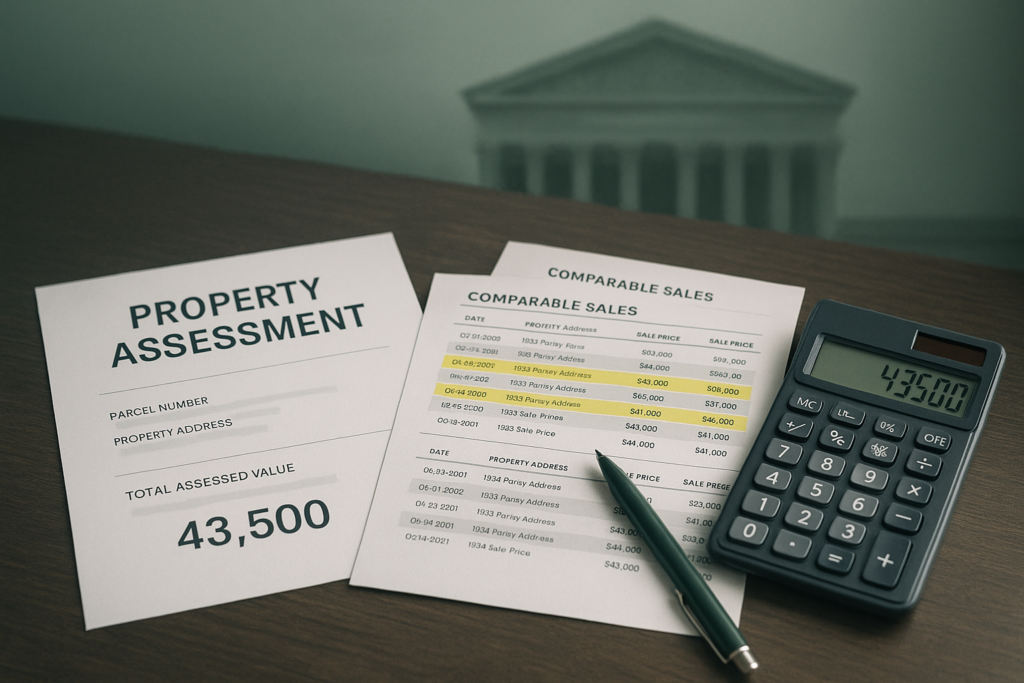
Section 3. Comparable sales grid
For each comp:
- Address
- Sale date
- Sale price
- Size
- Key similarity note
- Key difference note
Section 4. Condition evidence
- Photos
- Repair estimates if applicable
Section 5. Supporting documents
- Prior appraisal if relevant
- Exemption paperwork if the issue overlaps admin correction
Make it easy for someone else to follow your logic in five minutes.
Hearing Day: How to Not Blow It
You do not need to be dramatic. You need to be organized.
Good hearing behavior
- Be concise
- Stick to facts
- Lead with the strongest evidence
- Answer questions directly
- Stay professional even if the process feels mechanical
Bad hearing behavior
- Complaining about taxes in general
- Attacking the county staff personally
- Talking too long about unrelated financial stress
- Using emotional arguments instead of market data
Boards hear endless weak appeals. Standing out usually means being calmer and more prepared than everyone else.
Real-World Example
Scenario
A homeowner receives a notice showing an assessed value of $468,000.
After checking the record and recent sales, they find:
- County shows 2,520 square feet, but actual living area is 2,310
- Home has original 1990s kitchen and baths
- Roof near replacement window
- Three close comparable sales closed from $418,000 to $439,000
Likely strong appeal case?
Yes.
Why?
Because the owner has both:
- a factual record issue, and
- market evidence showing the county number may be high.
That combination is much better than just saying the value feels inflated.
The Deadline Problem
Counties do not care that you were busy.
Assessment notices and appeal windows can move fast. If you think your value is high, check the notice immediately and find the filing deadline that day.
Best practice
When the notice comes in:
- Put the deadline on your calendar
- Pull your property record
- Pull nearby sales
- Decide within a week whether you have a case
What an Appeal Can Actually Save You
The savings depend on your local tax rate and how much value gets reduced.
Example
- Assessed value reduction: $35,000
- Effective tax rate: 1.8%
- Approximate annual savings: $630
If that reduction influences future years too, the total benefit can compound nicely.
That is why a one-time effort can be worth doing.
OwnerHacks Quick Take
The best property tax appeals are boring.
That is the point.
They are built on:
- correct data,
- good comps,
- clear photos,
- and a short argument that survives scrutiny.
If your case depends on passion, you probably do not have much of a case.
Bottom Line
A property tax appeal is not about fighting city hall with righteous anger. It is about proving that the number on the notice does not line up with the property facts or the market.
If you have the evidence, appeal.
If you do not, do not waste energy pretending emotion will substitute for data.
Homeowners who treat the process like a file review usually do better than homeowners who treat it like a protest.
Sources reviewed
- Florida Department of Revenue property tax and Value Adjustment Board guidance
- County property appraiser assessment, exemption, and appeal instructions
- County tax collector billing and millage references
- Standard comparable-sale and property-record review practices used in residential valuation disputes
If this, do this next
Official resources and reference points
This page is homeowner education, not a property-specific appraisal, legal opinion, tax advice, or lender/carrier instruction. Use the tax bill, trim notice, exemption status, and local filing deadline before you assume the problem is the assessed value itself.
Why this article is worth trusting
Caleb Hollis reviewed this page. He reviews homeowner education on home value logic, cost realism, Florida housing questions, and decision quality.
See the reviewer profile and editorial team profile for who does what. OwnerHacks publishes homeowner education, not property-specific appraisal work, legal advice, tax advice, lending advice, or insurance advice.
OwnerHacks updates articles when rules, costs, or homeowner decision factors materially change. If something looks outdated, use our contact page and we will review it.