
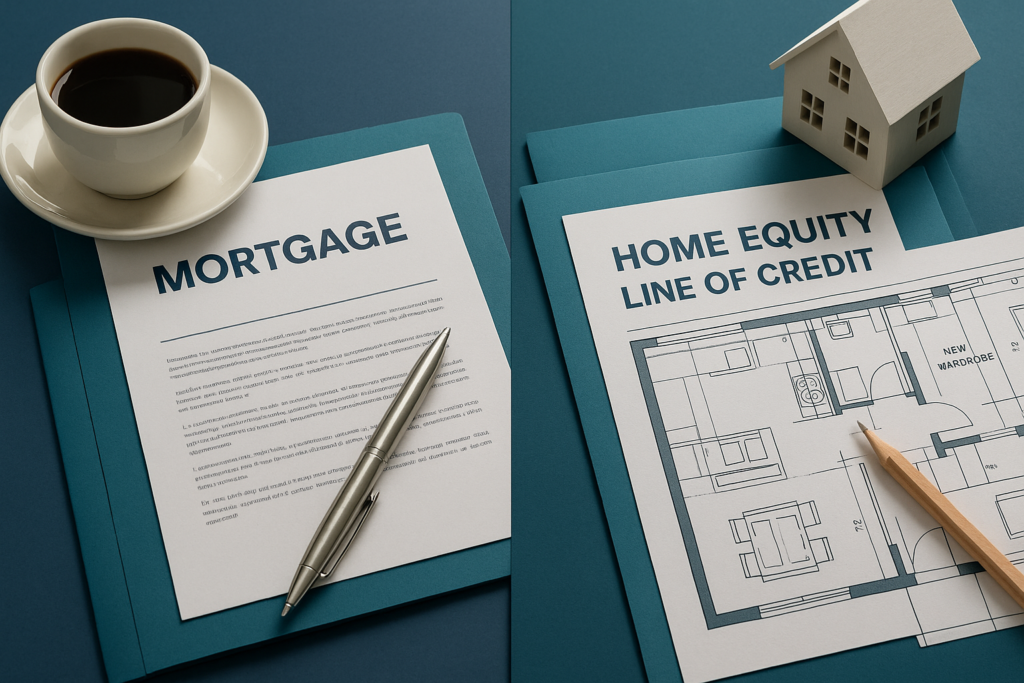
- This choice usually turns on one question first, is your current first mortgage worth protecting?
- Scenario picker
- Check credit before comparing cash-out options
- Decision matrix
- Worked decision paths
- Risk and reward cards
Show all sections
- Bottom line
- The Fast Version
- First, Understand What Each One Actually Does
- The First Real Question: Are You Protecting a Great First-Mortgage Rate?
- The Second Question: Do You Need a Lump Sum or Flexible Access?
- The Third Question: Fixed Payment Certainty or Variable Rate Flexibility?
- The Hidden Math Most Articles Skip: Repricing Old Debt
- Monthly Payment Framework
- A Better Decision Matrix
- Real-World Scenarios
- Scenario 1: The Rate-Protect Homeowner
- Scenario 2: The Payment-Sensitive Debt Consolidator
- Scenario 3: The Uncertain Project Planner
- Scenario 4: The Long-Stay Homeowner Who Hates Payment Volatility
- Closing Costs Matter More for Cash-Out Refi
- Break-Even Thinking
- When the Wrong Choice Becomes Dangerous
- Tax Considerations
- Do You Need an Appraisal?
- OwnerHacks Decision Framework
- Bottom Line
- Sources reviewed
This choice usually turns on one question first, is your current first mortgage worth protecting?
If the first rate is a gem, a HELOC often wins by default. If the whole loan structure needs help and you want one fixed payment, cash-out refinance gets stronger.
Scenario picker
Protect the first mortgage
Best for: current rate is far better than today
Why it wins: Replacing cheap debt just to pull cash can be an expensive own goal.
Affiliate resource
Check credit before comparing cash-out options
Cash-out refinances and HELOCs both depend heavily on credit, pricing, and lender terms. Review credit factors before assuming one option is cheaper.
Disclosure: This is a sponsored affiliate link. OwnerHacks may earn a commission if you use it, at no extra cost to you.
Need one clean payment
Best for: you want a fixed structure and a large lump sum now
Why it wins: Cash-out refinance may justify itself if the full-loan math works.
Need staged access
Best for: renovation timing or spending is messy
Why it wins: HELOC flexibility can beat over-borrowing on day one.
Decision matrix
| Decision point | Cash-out refinance | HELOC | Usually better |
|---|---|---|---|
| What happens to first mortgage | Replaced | Stays intact | HELOC if current rate is excellent |
| How funds arrive | Lump sum | Draw as needed | Depends on timing |
| Rate setup | Often fixed | Usually variable | Depends on payment tolerance |
| Upfront cost | Usually higher | Usually lower | HELOC on friction |
| Behavior risk | Resetting whole loan | Redrawing and carrying revolving debt | Discipline decides |
Worked decision paths
Owe $250,000 at 3.1%, need $50,000
Call: HELOC is usually cleaner
Protecting cheap old debt often matters more than shaving the payment optics.
Current mortgage is already ugly and you need $80,000 now
Call: Cash-out refinance may win
If the entire structure improves, replacing the first loan can make sense.
Projects will unfold over 12 months
Call: HELOC usually fits better
Borrowing everything upfront is dead weight if you will not use it yet.
Risk and reward cards
Cash-out upside
- One fixed payment
- Can improve whole-loan structure
- Clear lump-sum planning
HELOC / cash-out traps
- Blowing up a great rate
- Ignoring variable-rate payment shock
- Using equity for bad debt habits
Bottom Line
Start with the first mortgage you already have. That usually tells you which tool deserves the lead.
Best next move
Compare this with HELOC vs home equity loan, whether refinancing makes sense in 2026, and how valuation affects a HELOC.
If you have equity and need money, the internet gives you two loud answers:
- get a cash-out refinance,
- or open a HELOC.
Most articles stop there and give you a shallow pros-and-cons table.
That is not enough.
The right choice depends on what you are solving for.
Do you need the lowest payment now? the least long-term interest? flexibility? certainty? speed? protection from variable rates? room for repeated borrowing?
This guide gives you a cleaner way to decide.
The Fast Version
Cash-out refinance usually makes more sense when:
- your current mortgage rate is not dramatically better than today’s rate,
- you want one fixed payment,
- you need a larger lump sum,
- and you plan to stay in the home long enough to justify closing costs.
HELOC usually makes more sense when:
- you already have a very low first-mortgage rate,
- you want to preserve it,
- you need flexible access to funds,
- or you are not sure you need the full amount immediately.
That is the quick answer.
Now the real framework.
First, Understand What Each One Actually Does
Cash-out refinance
You replace your current mortgage with a new, larger mortgage and pocket the difference in cash.
Example:
- Current mortgage balance: $240,000
- New mortgage: $300,000
- Cash to you before costs: about $60,000
You now have one new loan, one new payment, one new interest rate.
HELOC
A home equity line of credit sits alongside your current mortgage as a separate loan. You keep the first mortgage in place and borrow against available equity through a revolving credit line.
You end up with:
- original mortgage,
- plus HELOC payment obligations.
That means two debt layers instead of one.
The First Real Question: Are You Protecting a Great First-Mortgage Rate?
This is the fork in the road.
If you have a first mortgage at 2.75%, 3.00%, or even low 4s, replacing it with a much higher-rate cash-out refi can be financially ugly.
That is why HELOCs became much more attractive when mortgage rates rose.
Example
Option A: cash-out refi
- Current balance: $250,000 at 3.0%
- Refinance to: $320,000 at 6.75%
You got cash, but you also repriced the entire old balance.
Option B: HELOC
- Keep $250,000 at 3.0%
- Add HELOC for only what you need
In many cases, preserving that cheap first mortgage is the whole game.
If your current rate is excellent, a HELOC often starts with a big strategic advantage.
The Second Question: Do You Need a Lump Sum or Flexible Access?
Better fit for cash-out refi
- one-time major renovation
- debt consolidation with a defined payoff plan
- large planned expense
- simplifying into one loan
Better fit for HELOC
- phased renovation projects
- uncertain budget timing
- emergency reserve access
- repeated borrowing needs
- short-term bridge use
A lot of homeowners borrow too much with a cash-out refi because the money arrives all at once. Flexibility can be a real benefit if you trust yourself not to abuse it.
The Third Question: Fixed Payment Certainty or Variable Rate Flexibility?
This is about risk tolerance.
Cash-out refinance
Usually gives you a fixed rate and predictable monthly payment.
HELOC
Often comes with a variable rate, at least initially. That means the payment can move.
If rates rise, your HELOC cost rises. If you are already stretched, that matters.
Example
A $75,000 HELOC balance might feel manageable at one rate, then noticeably worse after rate resets.
If sleep matters and budget stability matters, fixed can be worth paying for.
The Hidden Math Most Articles Skip: Repricing Old Debt
This is the most important concept in the whole decision.
When you do a cash-out refi, you are not just financing the new money you want.
You are refinancing the entire old mortgage balance too.
That means the true question is not:
"What rate do I get on the cash I need?"
It is:
"What is the cost of replacing my current mortgage terms on the entire balance?"
Example
You need $50,000.
You currently owe $260,000 at 3.125%.
A new cash-out refi gives you $310,000 at 6.875%.
You did not just finance $50,000 at 6.875%.
You repriced $260,000 of cheap debt into expensive debt.
That can swamp the benefit unless the refinance solves a bigger problem.
Monthly Payment Framework
Homeowners often chase the wrong monthly number.
Cash-out refi payment logic
- one blended payment
- often stretched over 15, 20, or 30 years
- can lower the immediate monthly burden because repayment is spread out
HELOC payment logic
- second payment layered on top
- draw-period payments may be interest-only or lower initially
- repayment period can later become much more painful
This is where people fool themselves.
A HELOC can look cheap at the start if the payment is interest-only during the draw period. That does not mean it stays cheap.
A Better Decision Matrix
Pick cash-out refi if most of these are true:
- You do not have an ultra-low existing mortgage rate to protect
- You want long-term fixed payment certainty
- You need a large amount all at once
- You want one loan instead of two
- You plan to stay long enough to spread out closing costs
- The refinance also improves something else, like term structure or payment affordability
Pick HELOC if most of these are true:
- Your existing first mortgage rate is excellent
- You only need part of the money now
- You want borrowing flexibility
- You may pay it down and redraw
- You can tolerate variable-rate risk
- You do not want to reset your first mortgage timeline
Real-World Scenarios
Scenario 1: The Rate-Protect Homeowner
- Mortgage balance: $220,000 at 2.875%
- Equity available: strong
- Need: $40,000 for phased renovations over 18 months
Better fit
HELOC.
Why
Resetting a cheap first mortgage for a modest cash need is usually bad math. The flexibility also matches phased spending.
Scenario 2: The Payment-Sensitive Debt Consolidator
- Mortgage balance: $310,000 at 5.875%
- Need: $70,000 to clear higher-interest debt and fund one-time expenses
- Wants predictable payment
Better fit
Potentially cash-out refi.
Why
If the current first mortgage rate is not dramatically better than market, rolling everything into one fixed structure may create cleaner long-term control.
Scenario 3: The Uncertain Project Planner
- Mortgage balance: $280,000 at 3.25%
- Need: maybe $25,000, maybe $80,000
- Projects depend on contractor bids
Better fit
HELOC.
Why
Borrowing flexibility beats over-borrowing. Protecting the 3.25% first mortgage is also a major win.
Scenario 4: The Long-Stay Homeowner Who Hates Payment Volatility
- Mortgage balance: $265,000 at 5.5%
- Need: $90,000 for a major remodel
- Will stay 10+ years
- Wants fixed payment certainty
Better fit
Often cash-out refi, assuming the final rate and closing cost math are acceptable.
Why
This owner values certainty and time horizon enough that a fixed structure may be worth it.
Closing Costs Matter More for Cash-Out Refi
Cash-out refinances usually come with fuller mortgage-style closing costs.
HELOCs may have lower upfront costs, though they are not always free. Some lenders charge appraisal, annual, inactivity, early closure, or termination fees.
What to compare
- Origination fees
- Appraisal costs
- Title-related fees
- Annual fees
- Prepayment or early closure terms
- Minimum draw rules
Do not compare only rate. Compare friction.
Break-Even Thinking
If a cash-out refi costs meaningfully more upfront, you need to justify it through:
- lower blended payment burden,
- fixed-rate stability,
- or other strategic benefits.
Ask
How long do I need to keep this loan for the advantages to outweigh the costs?
If you may move in two years, paying full refinance freight can be hard to justify.
When the Wrong Choice Becomes Dangerous
HELOC risk traps
- Using the draw period as an excuse to underpay principal
- Treating the credit line like a lifestyle upgrade tool
- Ignoring variable rate risk
- Forgetting the repayment phase can jump the payment
Cash-out refi risk traps
- Refinancing a very low-rate first mortgage unnecessarily
- Stretching short-term spending over 30 years
- Pulling too much cash just because it is available
- Ignoring the cost of resetting amortization
Both tools can be useful. Both can also become expensive self-deception.
Tax Considerations
Tax treatment can change and depends on your use of funds and personal situation. Interest may be treated differently depending on whether borrowed funds are used to substantially improve the home securing the loan.
Do not make this decision based on outdated forum advice. Verify current tax rules with a qualified tax professional if deduction treatment matters to the plan.
Do You Need an Appraisal?
Often yes, at least in some form of valuation review, especially if the lender needs to verify current equity position.
That matters because your final options may depend on how strong your appraised value comes in.
If your equity estimate is fantasy, your loan menu changes fast.
OwnerHacks Decision Framework
Run these five questions in order:
1. Is my current first mortgage rate too good to touch?
If yes, HELOC gets a major boost.
2. Do I need all the money now?
If no, HELOC gets another boost.
3. Can I handle variable payment risk?
If no, cash-out refi gains ground.
4. Am I staying long enough to justify refinance costs?
If yes, cash-out refi becomes more credible.
5. Am I solving a short-term cash need with long-term debt in a dumb way?
If yes, stop and rethink the whole plan.
That last question saves people a lot of pain.
Bottom Line
Cash-out refinance vs HELOC is not really a product comparison. It is a strategy comparison.
Choose the tool that matches your actual constraint:
- protect a great first mortgage,
- preserve flexibility,
- lock payment certainty,
- or simplify repayment.
If your current mortgage rate is excellent, HELOC often wins by default.
If your rate is not special and you want one fixed structure, cash-out refi can make sense.
Just do not let easy access to equity trick you into solving a temporary problem with permanent expensive debt.
Sources reviewed
- Consumer Financial Protection Bureau HELOC and mortgage refinance guidance
- Freddie Mac My Home home equity borrowing guidance
- Fannie Mae consumer mortgage and collateral references
- Standard second-lien, variable-rate, and refinance closing-cost references
If this, do this next
Official resources and reference points
This page is homeowner education, not a property-specific appraisal, legal opinion, tax advice, or lender/carrier instruction. Use these when the decision touches borrowing against equity, deed changes, or appraisal-driven loan questions where one wrong assumption gets expensive fast.
Why this article is worth trusting
Caleb Hollis reviewed this page. He reviews homeowner education on home value logic, cost realism, Florida housing questions, and decision quality.
See the reviewer profile and editorial team profile for who does what. OwnerHacks publishes homeowner education, not property-specific appraisal work, legal advice, tax advice, lending advice, or insurance advice.
OwnerHacks updates articles when rules, costs, or homeowner decision factors materially change. If something looks outdated, use our contact page and we will review it.